Category Archives: All The News That’s Fit To Blog

Expert Reports

Last year, the U.S. Supreme Court dismissed the NVIDIA appeal as improvidently granted. The case presented the issue of whether expert reports can be used to satisfy the heightened pleading standards of the Private Securities Litigation Reform Act of 1995 (PSLRA). How have lower courts addressed the use of expert reports in securities fraud complaints in the aftermath of the Court’s decision?

The author of The 10b-5 Daily (Lyle Roberts) has co-authored a Law360 article on the topic. The article can be found here.

Leave a comment

Filed under All The News That's Fit To Blog, Motion To Dismiss Monitor

Risky Business

The author of The 10b-5 Daily (Lyle Roberts) has co-written an article on Law360 about the use of risk disclosures as alleged misstatements in securities class actions. The article discusses the current circuit split on the issue, the Supreme Court’s decision to drop the Facebook case, the pending Adidas case, and where this all may be headed.

The article can be found here: https://www.law360.com/articles/2361203/gauging-the-risky-business-of-business-risk-disclosures

Leave a comment

Filed under All The News That's Fit To Blog, Uncategorized

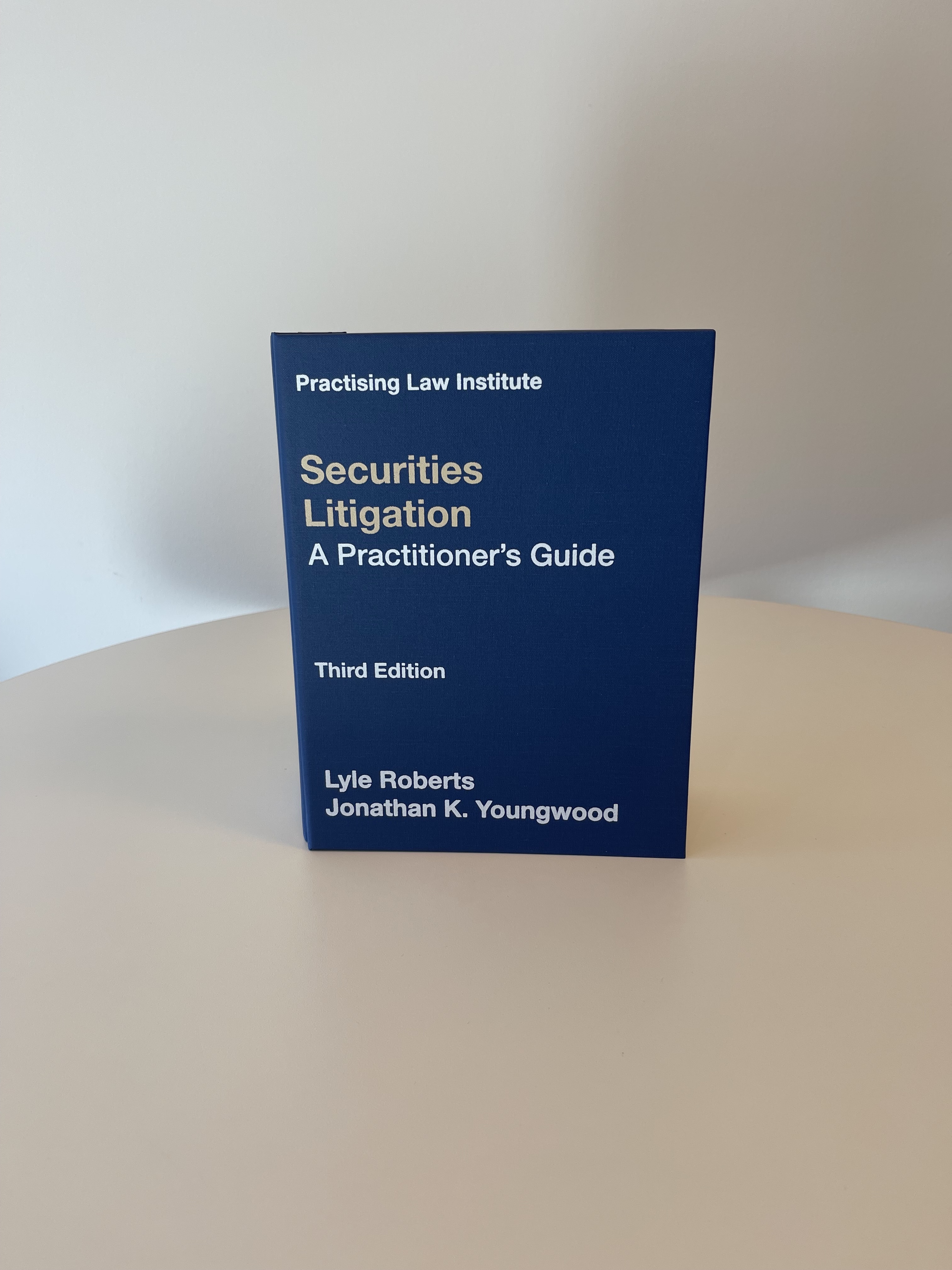
Securities Litigation: A Practitioner’s Guide

The author of the The 10b-5 Daily – Lyle Roberts – also is the co-editor of the new third edition of PLI’s “Securities Litigation: A Practitioner’s Guide.” The leading treatise in this area of the law, it is a joint project between partners from A&O Shearman and Simpson Thacher.

The treatise is completely revised and offers a comprehensive, practical, and readable overview of every aspect of private securities litigation. In addition to being the editor, I also am the co-author of the chapters on “Lead Plaintiffs under the PLSRA” and “Settlement Considerations.” I am confident that anyone interested in this area of the law (which presumably includes the readers of this blog!) will find it useful. The treatise is updated every year and can be ordered here.

Leave a comment

Filed under All The News That's Fit To Blog

The No Good, Very Bad Insider Trading Prohibition Act

The author of The 10b-5 Daily (Lyle Roberts) wrote an op-ed last year arguing that the Insider Trading Prohibition Act passed by the House of Representatives was severely flawed. The bill went to the Senate, but died from deserved inaction. Last month the bill was passed again and its sponsors hope it will receive a more favorable reception now. Unfortunately, the legislation has not gotten any better in the interim.

Lyle Roberts and Professor M. Todd Henderson (U. of Chicago Law School) have published a new op-ed in The Hill discussing how the Senate could fix what the House has wrought. Stay tuned.

Leave a comment

Filed under All The News That's Fit To Blog, Uncategorized

Please Take This Case!

It has been over fifteen years since the U.S. Supreme Court’s decision in Dura Pharmaceuticals v. Broudo, where the Court held that plaintiffs in securities fraud cases must plead and prove loss causation. In the interim, the lower courts have gone in a number of different directions on crucial loss causation questions

The author of The 10b-5 Daily (Lyle Roberts) has written an article for Law360 urging the Court to grant cert in the In re BofI Securities Litigation case. In that case, the U.S. Court of Appeals for the Ninth Circuit created a clear circuit split on the issue of whether a third-party judicial complaint, standing alone, can be a “corrective disclosure” for purposes of loss causation. Here is a link to the article (may require subscription).

Leave a comment

Filed under All The News That's Fit To Blog, Appellate Monitor, Uncategorized

All The CLE You Could Possibly Want

It is not too late to sign up for PLI’s Handling a Securities Case 2014: From Investigation to Trial and Everything in Between. The program takes place on Thursday, April 24 in New York and via webcast (and, shortly thereafter, on demand). The details can be found here.

Lyle Roberts of Cooley LLP (the author of The 10b-5 Daily) is co-chairing the program. The outstanding faculty will cover a wide range of topics, all while following a hypothetical case from the initial investigation through trial. There even will be a panel on ethical issues, for those in need of ethics credits.

Leave a comment

Filed under All The News That's Fit To Blog

Around The Web

A couple of interesting items from around the web.

(1) The New York Law Journal (June 10) has a column on the potential impact of the recent GAMCO v. Vivendi decision. In GAMCO, the court found that the plaintiff was not entitled to a fraud-on-the-market presumption of reliance because its trading strategy did not rely on the market price of Vivendi’s stock as an accurate measure of its value. The column’s authors suggest that in light of this decision, “defendants going forward should delve deeply into a plaintiff-investor’s decision-making process in an attempt to sever the link with market price.”

(2) The D&O Diary has a guest post from two Stanford professors who have studied the outcomes of securities class actions. Their findings, for the period from 2000 to 2010, include: (a) during that period there was no statistically significant change in the overall dismissal rate, (b) half of all settlements occured before a final ruling on a motion to dismiss and half occured after the motion to dismiss had been denied and the case had moved to discovery, and (c) the insurer contribution to settlements was higher among cases filed in the second half of the past decade than in the first half.

Leave a comment

Filed under All The News That's Fit To Blog

All The CLE You Could Possibly Want

It is not too late to sign up for PLI’s Handling a Securities Case 2013: From Investigation to Trial and Everything in Between. The program takes place on Thursday, April 25 in New York and via webcast. The details can be found here.

Lyle Roberts of Cooley LLP (the author of The 10b-5 Daily) is co-chairing the program. The outstanding faculty will cover a wide range of topics, all while following a hypothetical case from the initial investigation through trial. There even will be a panel on ethical issues, for those in need of ethics credits.

Hope to see you there.

Leave a comment

Filed under All The News That's Fit To Blog

Who Knew The Truth?

Should a securities class action defendant be able to get discovery from absent class members to support its defenses? In Garden City Employees’ Retirement System v. Psychiatric Solutions, Inc., 2012 WL 4829802 (M.D. Tenn. Oct. 10, 2012), the defendants issued subpoenas to 14 institutional investors in a case where the class had already been certified. In their motion for leave to conduct this discovery, the defendants contended that the discovery was necessary on “individual issues” and to further their “truth on the market defense.”

The court noted that, as a general matter, discovery of absent class members is disfavored. The defendants “bear the burden of showing necessity and the absence of any motive to take undue advantage of the class members.” In the instant case, the court concluded that mere “speculation” that absent class members might have invested even knowing of the alleged misstatements was insufficient to satisfy the defendants’ burden. Moreover, any discovery related to individual reliance on the alleged misstatements could be done after a trial on the common issues.

Holding: Motion for leave to conduct discovery of absent class members denied.

Leave a comment

Filed under All The News That's Fit To Blog

Defining Domestic

The New York Law Journal has a column (Aug. 17 edition – subscrip. req’d) on the application of the Morrison decision. In Morrison, the Supreme Court held that Section 10(b) liability for securities fraud is limited to “transactions in securities listed on our domestic exchanges, and domestic transactions in other securities.” What constitutes a “domestic transaction,” however, was not clarified.

As a result, the authors note, lower courts have adopted at least three different approaches for determining whether a non-exchange transaction is “domestic.” Some courts have looked at whether the “critical steps of the transaction,” including the offer and acceptance, occurred in the United States. Other courts limit potential liability to transactions in which the parties agreed to be bound to each other in the United States. The strictest approach is to insist that the actual transfer of the securities must have taken place in the United States. The authors argue that all of these approaches are broader than what the Supreme Court intended.

Quote of note: “When any of these approaches is applied to Morrison, it becomes clear that the lower courts’ applications of Morrison are inconsistent with the Supreme Court’s ruling and do not end extraterritorial application of the 34 Act. If [the Morrison corporate defendant] had hypothetically transferred its stocks to the investors in New York, for example, the 34 Act arguably would have applied under all three approaches. Ironically, under the prior conduct and effects tests, the same hypothetical would likely not have triggered the application of the 34 Act.”

Leave a comment

Filed under All The News That's Fit To Blog