Expert Reports

Last year, the U.S. Supreme Court dismissed the NVIDIA appeal as improvidently granted. The case presented the issue of whether expert reports can be used to satisfy the heightened pleading standards of the Private Securities Litigation Reform Act of 1995 (PSLRA). How have lower courts addressed the use of expert reports in securities fraud complaints in the aftermath of the Court’s decision?

The author of The 10b-5 Daily (Lyle Roberts) has co-authored a Law360 article on the topic. The article can be found here.

Leave a comment

Filed under All The News That's Fit To Blog, Motion To Dismiss Monitor

How New Is The News?

The Basic presumption of reliance in securities fraud class actions allows plaintiffs to assert, for class certification purposes, that they were defrauded when they relied “on the integrity of the price set by the market” for the stock because a misrepresentation purportedly distorted that price.  But plaintiffs may invoke the Basic presumption only if the stock traded in an “efficient market” in which the stock price quickly and completely absorbs published information.  If that is not the case, the Basic presumption no longer makes sense as there would be no basis for presuming that an alleged misrepresentation distorted the stock price.

In attempting to establish class certification using the Basic presumption, plaintiffs frequently rely on a “corrective disclosure” as the source of price impact.  In other words, plaintiffs argue that they have demonstrated price impact based on a corrective disclosure that led to a stock price decline.   In this scenario, however, the corrective disclosure presumably must disclose new information.  That is because, under the efficient markets theory, confirmatory information—or information already known by the market—will not cause a change in the stock price. If a defendant shows that the corrective disclosure does not reveal new information, then the defendant arguably has severed the link between the alleged misstatement and the stock price drop and the Basic presumption should not be applied.

Two recent unpublished circuit court decisions in high-profile cases have addressed the issue of whether the disclosure of “new” information is required to support the existence of a price impact under the Basic presumption, with results that appear to suggest that there is judicial confusion over how the efficient markets theory should be applied.

In San Diego County Employees Retirement Assoc. v. Johnson & Johnson, 2025 WL 2176586 (3rd Cir. July 30, 2025), the panel reasoned – over a vigorous dissent – that for purposes of assessing price impact under the Basic presumption it “need not decide whether J&J’s assertion that a disclosure must be new is correct” because “disclosures based on public information may nevertheless communicate a new signal to the market in certain situations.”  The panel found that the alleged corrective disclosures sent “new signals” to the market that impacted the stock price, even if they did not reveal new information.  The defendants sought en banc review of the decision, with significant amicus support, but the Third Circuit did not grant the review (although several judges voted in favor).

In Jaeger v. Zillow Group, Inc., 2025 WL 2741642 (9th Cir. Sept. 26, 2025), the panel rejected the defendants’ argument that an analyst report “did not disclose new information about Zillow’s overpayment for houses” and therefore could not have had a stock price impact.  Instead, the panel concluded that even if the information was already public, the “record suggests that this information was not widely discussed or accessible until the [analyst] report was released.”  The defendants have obtained an extension on the time to seek a panel rehearing or en banc hearing until October 24, 2025.

It will be interesting to see whether either of these appeals move forward, as it is clear that there needs to be judicial clarification over whether plaintiffs can cite “new signals” or an alleged failure of the information to be “widely discussed” to defeat a defendant’s showing that the alleged corrective disclosure did not contain new information that led to a stock price impact.  Stay tuned.

Note: The author of The 10b-5 Daily assisted the Washington Legal Foundation in filing an amicus brief in support of en banc review in the Johnson & Johnson case.

Leave a comment

Filed under Appellate Monitor

Compare and Contrast – Midyear 2025

NERA Economic Consulting and Cornerstone Research have released their 2025 midyear reports on securities class action filings.  The different methodologies employed by the two organizations usually lead to slightly different numbers.

The key findings include:

(1) The reports agree that filings held steady as compared to 2024, with only a handful of merger objection cases.  NERA found that there were 108 filings in the first half of 2025, while Cornerstone found that there were 114 filings in the first half of 2025.

(2) The categories of filings that both reports identify as growth areas are artificial intelligence (12-13 filings) and cryptocurrency (6-8 filings).

(3) Both reports find that the number of filings against non-U.S. issuers continues to decline, with 12 filings in the first half of 2025. On an annualized basis (24 filings), this would be the lowest number of filings against non-U.S. issuers in ten years.

(4) The dismissal rate for cases is up sharply. NERA finds that there were 121 cases resolved in the first half of 2025, of which 87 were dismissed and 34 were settled (there were a total of 124 dismissals in 2024).

The NERA report can be found here and the Cornerstone report can be found here.

Leave a comment

Filed under Lies, Damn Lies, And Statistics

Risky Business

The author of The 10b-5 Daily (Lyle Roberts) has co-written an article on Law360 about the use of risk disclosures as alleged misstatements in securities class actions. The article discusses the current circuit split on the issue, the Supreme Court’s decision to drop the Facebook case, the pending Adidas case, and where this all may be headed.

The article can be found here: https://www.law360.com/articles/2361203/gauging-the-risky-business-of-business-risk-disclosures

Leave a comment

Filed under All The News That's Fit To Blog, Uncategorized

Looks Prehistoric

An ongoing issue in securities litigation is to what extent a short seller’s report can act as a corrective disclosure for purposes of establishing loss causation.  The U.S. Court of Appeals for the Fourth Circuit had the opportunity to address that issue for the first time last week.

In Defeo v. IonQ, Inc., 2025 WL 1035292 (4th Cir. April, 8, 2025), the plaintiffs alleged that a short seller report had revealed to investors that IonQ, which makes quantum computing systems, did not have a working product and its revenues were driven by phony related-party transactions.  The company responded to the report with a short press release deriding the report’s inaccuracies and then later issued a longer rebuttal.  The company’s stock price declined during this period.

The district court held that the plaintiffs’ complaint did not contain any reliable sources and therefore failed to adequately plead the elements of a federal securities claim.  In addressing a subsequent amended complaint, however, the district court found that the amendment was futile solely on the basis that the plaintiffs could not adequately plead loss causation.

On appeal, the Fourth Circuit only addressed the issue of loss causation.  As to the short seller report, the court noted that while short seller reports could potentially act as corrective disclosures, in this instance the report “relies on anonymous sources for its nonpublic information and disclaims its accuracy.”  Indeed, as to the report’s use of sources, the publisher stated that some quotations “may be paraphrased, truncated, and/or summarized solely at our discretion, and do not always represent a precise transcript of those conversations.”  Under these circumstances, the Fourth Circuit concluded that the “potential evidentiary value [of the report] evaporates” and it could not form the basis for loss causation.

Alternatively, the plaintiffs argued that the company’s initial response to the short seller report, which did not provide a point-by-point rebuttal, revealed to investors that the report was to some extent accurate.  The Fourth Circuit noted it could “envision a scenario where a third party exposes some unverified bombshell about a company and the company’s tacit mea culpa could function as a verification of that bombshell” but that this “theory holds no water here.”  The company’s press release generally rejected the report’s allegations.

Holding: Judgment of the district court finding amendment futile affirmed.

Quote of note: “The Report’s publisher admits some quotations ‘may be paraphrased, truncated, and/or summarized solely at our discretion, and do not always represent a precise transcript of those conversations.’ That disclosure is particularly troubling because it gives Scorpion Capital the kind of editorial license that could allow it to say just about anything and cloak it in the imprimatur of truth in order to make a buck. For example: If an expert represented, ‘IonQ’s 32-qubit system is revolutionary. By comparison, Company Y’s system looks prehistoric,’ Scorpion Capital gave itself the freedom to say, ‘IonQ’s 32-qubit system looks prehistoric,’ and attribute that quote to an expert. In all, those disclosures lead to the conclusion that ‘the character of the’ Report ‘rendered it inadequate’ to reveal any alleged truth to the market.”

Leave a comment

Filed under Appellate Monitor, Uncategorized

A Risky Campaign

Last year, the U.S. Supreme Court had the opportunity in the Facebook case to address the extent to which corporate risk disclosures can form the basis for securities fraud liability.  After oral argument, however, the Court decided to dismiss the appeal as improvidently granted.  That has left the door open for a wide range of potential decisions from the lower courts.

In Craig v. Target Corp., 2024 WL 4979234 (M.D. Fla. Dec. 4, 2024), the court considered whether Target’s risk disclosures in its 2021 and 2022 annual reports about ESG and DEI initiatives were false and misleading because they failed to disclose that the company would embark on a Pride Month Campaign in May 2023 that could result in customer boycotts and loss of sales. Target generally had disclosed that negative reputational incidents could adversely affect its results and that it faced varied stakeholder expectations regarding how it addressed environmental, social, and governance matters.  In addition, Target previously had been the subject of a customer boycott as the result of its opposition to North Carolina’s 2016 transgender bathroom law. 

The court found, however, that Target had failed “to mention the specific risk of its upcoming 2023 Pride Month Campaign” and that the company knew or should have known that this particular campaign “posed a risk of backlash and financial repercussions.”

Holding: Motion to dismiss denied.

Quote of note: “Target’s plan to enact a new campaign – i.e., placing controversial merchandise at the center of its stores – could be construed as a change to their ESG/DEI campaigns in prior years.  Upon review of the amended complaint and the parties’ briefing, it is unclear whether this information was publicly available and it is further unclear how much information investors and Plaintiffs knew about the plans for the new campaign.  Thus, Plaintiffs have adequately pleaded that information revealed in the 2021 and 2022 risk disclosures may not have been complete.”

Leave a comment

Filed under Motion To Dismiss Monitor, Uncategorized

Compare and Contrast

NERA Economic Consulting and Cornerstone Research have released their respective 2024 annual reports on federal securities class action filings.  As usual, the different methodologies employed by the two organizations have led to slightly different numbers, although they both identify the same general trends.

The findings for 2024 include:

  1. The reports agree that overall filings have stayed steady. NERA finds that there were 229 filings (matching the number of filings in 2023), while Cornerstone finds that there were 225 filings (compared with 215 filings in 2023). Filings involving only Section 10(b)/Rule 10b-5 claims for securities fraud are an increasing percentage of the overall filings. Cornerstone found that 198 of the 225 filings fit this description, the highest level on record.  Relatedly, Cornerstone found that the number of federal and state 1933 Act filings decreased from 64 filings in 2022 to 32 filings in 2023 to 21 filings in 2024.
  1. NERA found that filings against companies in the technology and healthcare sectors combined accounted for more than half of all filings, and the Second and Ninth Circuits accounted for 61% of filings (excluding merger objections and crypto unregistered securities cases).
  1. Both reports agree that filings involving artificial intelligence (AI) claims are the fastest growing category. NERA and Cornerstone found that filings with AI-related claims more than doubled from 2023 to 2024 (NERA – 13 filings, Cornerstone – 15 filings).
  1. NERA found that after excluding cases involving merger objections, crypto unregistered securities, or settlements of $0 to the class, around 42% of settlements had a recovery of less than $10 million, another 40% had a settlement between $10 million and $49.9 million, and 18% settled for $50 million or more, largely mirroring the distribution of settlement values from 2023. The average settlement value in 2024 was $43 million, a roughly 7% decline relative to the 2023 inflation-adjusted average settlement value of $46 million.

The NERA report can be found here. The Cornerstone report can be found here.

Leave a comment

Filed under Lies, Damn Lies, And Statistics, Uncategorized

A Substantial Treat

In Macquarie, a recent decision from the U.S. Supreme Court, the Court addressed “half truth” liability for securities fraud.  Among other things, the Court noted that “the difference between an omission and a half-truth is the difference between a child not telling his parents he ate a whole cake and telling them he had dessert.  Rule 10b-5(b) does not proscribe pure omissions. . . . Put differently, it requires disclosure of information necessary to ensure that that statements already made are clear and complete (i.e., that the dessert was, in fact, a whole cake.)”  But how does this analogy work in the context of alleged material omissions in a company’s risk disclosures, which by their nature are talking about a dessert that has yet to be eaten (and may never be eaten)?

In Roofers Local N. 149 Pension Fund v. Amgen, Inc. 2024 WL 4358409 (S.D.N.Y. Sept. 30, 2024), the court considered a case involving Amgen’s risk disclosures surrounding its ongoing dispute with the IRS over back taxes.  The risk disclosures stated that the IRS’s proposed adjustments were “significant,” “substantial,” “may result in payments substantially greater than amounts accrued,” and “could have a material impact” on Amgen’s financial statements.  Amgen also disclosed that it did not agree with the adjustments and was contesting them.  What Amgen did not tell the market, however, was that the IRS had indicated to the company that it was seeking a total of $10.7 billion in back taxes.  When Amgen eventually disclosed the exact amounts that the IRS was seeking after receiving notices of deficiency, its stock price declined.  

As recognized in the Amgen decision, companies frequently decline to quantify the risks they face, instead using words like “significant” until the magnitude of the risks becomes more certain.  Nevertheless, the court found that the failure to disclose the $10.7 billion amount rendered Amgen’s risk disclosures materially misleading because investors were “left in the dark” about the magnitude of the potential liability.  While Amgen was “free to vigorously dispute the legal and factual merits of the IRS’s assessments, and to tell investors that it is doing so; what it cannot do consistent with Section 10(b) and Rule 10b-5, however, is present investors with an incomplete, unclear, and thus plausibly misleading picture of the financial risks posed by that dispute.”  Referring to the “whole cake” analogy used in Macquarie, the court noted that it did “not believe that the analogy would have come out differently had the child described his treat as merely ‘significant’ or ‘substantial’ instead.”

Holding: Motion to dismiss denied.

Leave a comment

Filed under Motion To Dismiss Monitor, Uncategorized

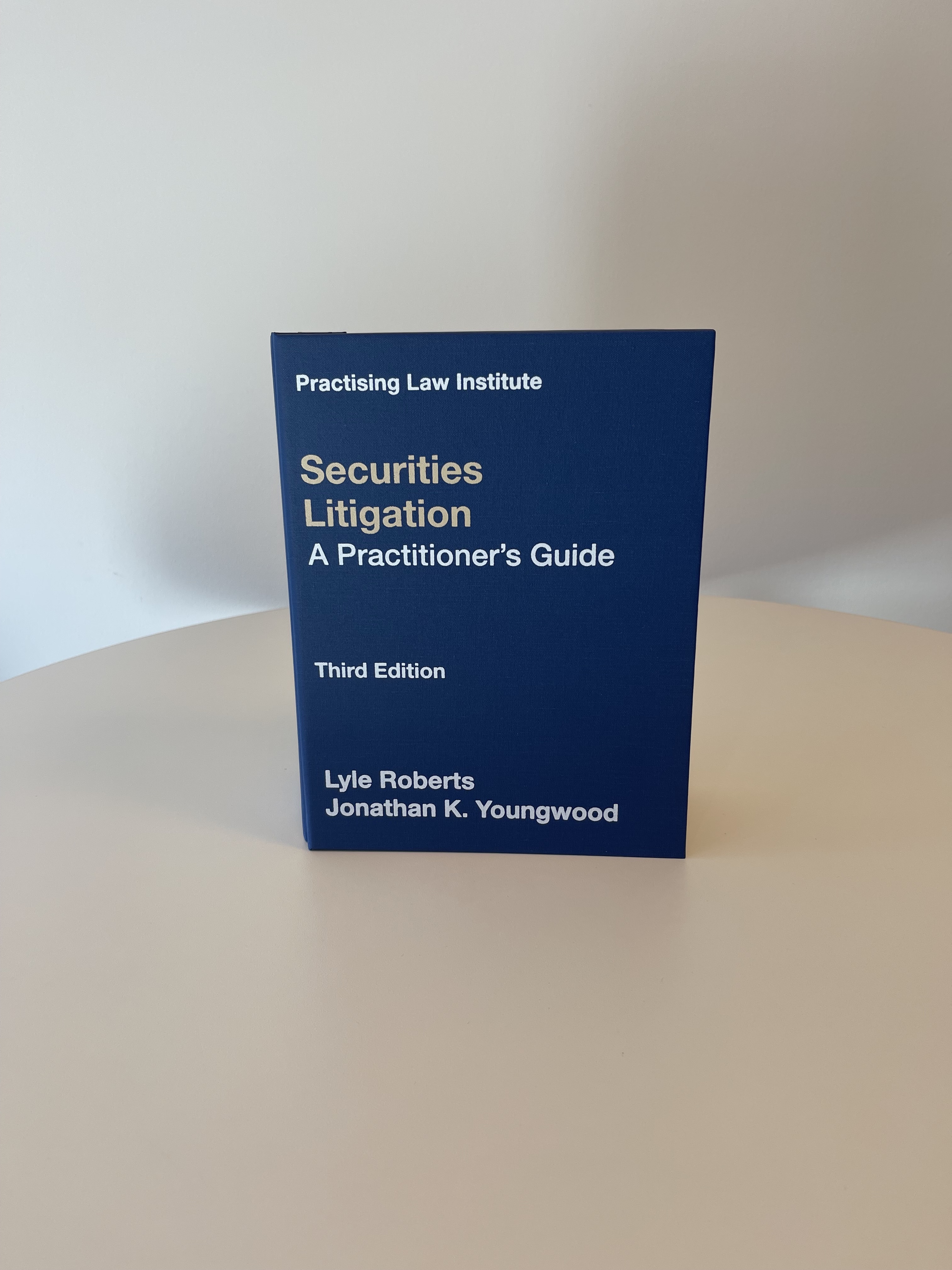
Securities Litigation: A Practitioner’s Guide

The author of the The 10b-5 Daily – Lyle Roberts – also is the co-editor of the new third edition of PLI’s “Securities Litigation: A Practitioner’s Guide.” The leading treatise in this area of the law, it is a joint project between partners from A&O Shearman and Simpson Thacher.

The treatise is completely revised and offers a comprehensive, practical, and readable overview of every aspect of private securities litigation. In addition to being the editor, I also am the co-author of the chapters on “Lead Plaintiffs under the PLSRA” and “Settlement Considerations.” I am confident that anyone interested in this area of the law (which presumably includes the readers of this blog!) will find it useful. The treatise is updated every year and can be ordered here.

Leave a comment

Filed under All The News That's Fit To Blog

Compare And Contrast – Midyear 2024

The 10b-5 Daily is catching up on posts after a very busy August and September, so thanks everyone for your patience. NERA Economic Consulting and Cornerstone Research released their 20224 midyear reports on securities class action filings in August.  While the different methodologies employed by the two organizations usually lead to slightly different numbers, they managed mostly to match for this report.

The key findings include:

(1) The reports agree that filings are at steady levels as compared to 2023, with only a handful of merger objection cases.  Both NERA and Cornerstone find that there were 112 filings in the first half of 2024 (up slightly from the second half of 2023).

(2) The categories of filings that both reports identify as potential growth areas for the year are COVID-19 (7-8 filings) and artificial intelligence (6 filings). In contrast, SPAC, cryptocurrency, and cybersecurity filings are down relative to past years.

(3) Both reports find that the annual number of filings against foreign companies is on track to be the lowest in the last ten years, even while the percentage of U.S. listings by foreign companies has steadily increased. For example, Cornerstone finds that foreign companies currently make up 24.7% of U.S. listings, but have only been the subject of 14.2% of the filings in the first half of 2024.

(4) NERA finds that there were 100 cases resolved in the first half of 2024, if which 52 were dismissed and 48 were settled.

The NERA report can be found here and the Cornerstone report can be found here.

Leave a comment

Filed under Lies, Damn Lies, And Statistics, Uncategorized